Showing posts with label plants. Show all posts

Monday

Aquatic Plant (Water Plants) - Leaf and Stem

Aquatic plant's leaf surface.
Aquatic plant's leaf surface (Water plant).
Magnification - 100 times.


Aquatic plant's leaf surface.
Aquatic plant's leaf surface. Magnification - 100 times.
Compare this with other plant leaves.


Aquatic plant's stem.Cross section.
Aquatic plant's stem. Cross section.
Magnification - 100 times.
Compare this with other plant stems.


Aquatic Plant.
Aquatic Plant. Direct view.


Stem of another normal plant.
Stem of another normal plant. (This image was created
by combining two images.) This plant has a thin and
strong stem. Magnification - 100 times.


             Aquatic Plants live under the water or floating on the water. Plants like  Duckweed,Water Hyacinth, Water Lettuce are examples for floating water plants. Plants like Eel grass,Water star grass, Hydrilla are  examples for submerged water plants. Lotus and  Water Lilyare the examples for Emergent water Plants. These plant have roots in the mud under thewater and have floating leaves.
              These plants have special adaptations like aerenchyma. Aerenchyma means air spaces in plants stems and leaves. It helps for buoyancy and allowing the circulation of gases.
              One of the largest aquatic plants in the world is the Amazon water lily. One of the smallestaquatic plants is the minute duckweed.


Links - External
Aquatic Plants - botgard.ucla.edu
Aquatic Plants -  aquaplant.tamu.edu

Plant Root cells

Roots functions : Absorb water and nutrients. Anchoring
the plant to the ground. Store food. Some type of plant's
roots go as for as more than 50 m into the ground. Some
types of plants have roots above the ground.E.g. Money
plant, mangrove genera trees etc.

Plant Root.  Magnification 450 times.
Plant Root. Magnification 450 times.


Root Cells
This photo shows the Root Cells. Root hairs are in the left
side.


Tip of the root
Tip of the root. Magnification 450 times.


Root cells
Root cells.


Root cells
Root Cells.


External links:
Plant Roots - Wikipedia
Plant Roots - Simple Wikipedia
Plant Roots - Cross section - Image - Wikipedia
Plant Roots - Tip of the root - Image - Wikipedia
Plant species to keep soil healthy. sciencedaily.com
-Lancaster University.


(Note:   Please verify with other sources for accurate information.)

Plant Cells - Apple Fruit and Others.

Apple Skin Cells
Apple Skin Cells. Magnification - 100 Times.


Apple Fruit Cells
Apple Fruit Cells. Magnification - 100 Times.


Brinjal (Egg plant) Cell
Brinjal (Egg plant) Cells. Magnification - 100 Times.


Weed Plant Parts. Magnification - 100 Times.


Weed Plant Parts. Magnification - 100 Times.


GOTO CONTENTS PAGE
How big is the 100 times magnification?

Saturday

Plant Cells - Leaf Cells - Stomata - Part-2

Plant Cells - Leaf cells - Stomata
 Stomata are tiny openings in the leaf surface, looks like a mouth. They do the functions of respiration and releasing water vapors. They helps to take carbon dioxide and expel the oxygen. The guard cells around the opening help to control the size of the opening.

Leaf cells - Stomata
Leaf surface.Stomata. Magnification - 450 Times.

Leaf cells - Stomata
Leaf surface. Stomata. Magnification - 450 Times.

Leaf surface.
Leaf surface of another plant .
Magnification - 100 Times.

Leaf surface.
Leaf surface. Magnification - 450 Times.

Leaf surface. Stomata. Magnification - 450 Times.
 Another plant's leaf surface. Stomata. Magnification - 450 Times.


Visual Appeal
Converted microscope images.


Interesting Facts ❗  ๐Ÿ˜ƒ

➽  The world's smallest flowering plant is the watermeal, or Wolffia globosa. They have the size of a grain of rice. The flower with the world's largest bloom is the Rafflesia arnoldii. This rare flower is found in the rain forests of Indonesia. It can grow to be 3 feet across and weigh up to 15 pounds. It has a very strong and horrible  odour of decaying flesh, earning it the nickname  corpse flower .

➽    The world's largest bloom is the Rafflesia arnoldii. It can grow to be 3 feet across and weigh up to 15 pounds.


๐Ÿ”ต  CELLS


Related Posts
๐Ÿ”ต  For more leaf cells click here.

External links
๐Ÿ”ต  Stomata - Wikipedia


(Note:  Please verify with other sources for accurate information.)

Thursday

Plant Cells - Chlorophyll - Leaf

Our Food Source!
Chlorophyll in the Plant Cells. Chlorophyll makes
food using sunlight and carbon dioxide. This process is called
photosynthesis. In this process oxygen is produced. It  is the
source of  oxygen in Earth's atmosphere.

Chlorophyll in the Plant  Cells
Leaf. Chlorophyll - The round green things.


Leaf.
Leaf. Inside view.


Chlorophyll in the Plant  Cells
Leaf.


 Interesting Facts ❗  ๐Ÿ˜ƒ

➽  The world's smallest flowering plant is the watermeal, or Wolffia globosa. They have the size of a grain of rice. The flower with the world's largest bloom is the Rafflesia arnoldii. This rare flower is found in the rain forests of Indonesia. It can grow to be 3 feet across and weigh up to 15 pounds. It has a very strong and horrible  odour of decaying flesh, earning it the nickname  corpse flower .

➽    The world's largest bloom is the Rafflesia arnoldii. It can grow to be 3 feet across and weigh up to 15 pounds.
 

๐Ÿ”ต  CELLS


External links
๐Ÿ”ต  Chlorophyll - Wikipedia

(Note: Please verify with other sources for accurate information.)

Monday

Flower cells - Pomegranate And Hibiscus - Plant Cells

Flower petal
Flower petal.


Pomegranate Flower
Pomegranate Flower petal.
Magnification - 100 Times.


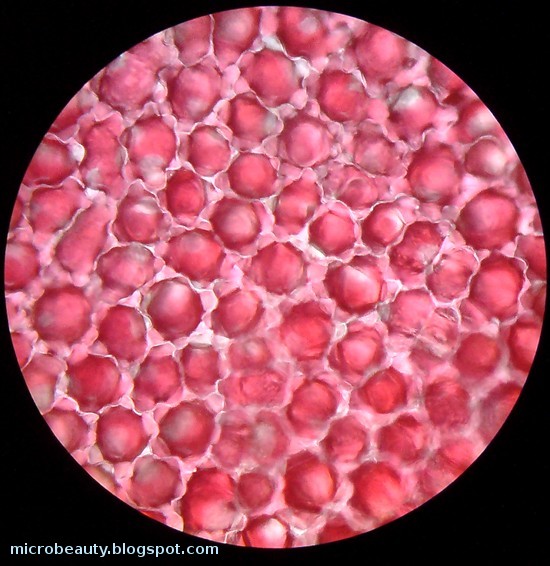
Pomegranate Flower Cells.
Pomegranate Flower Petal Cells.
Magnification - 450 Times.
The flower cells are usually round in shape. But the  Pomegranate Flower Petal Cells are irregular  in shape like a leaf cells.


Hibiscus ( Red)Flower petal Cells.
Hibiscus ( Red) Flower petal Cells.
Magnification - 450 Times.


Hibiscus( White) Flower cells
Hibiscus ( White) Flower petal Cells . Plant Cells.
Magnification - 450 Times.


Flower petal. Magnification - 100 Times.
This flower has double color.

The colors of the flowers are caused by pigments like Anthocyanin,
Betalains etc. The color pigment cells are placed near the surface of the flower petals.


 Hibiscus Flower.


Pomegranate Flower.


Interesting Facts ❗  ๐Ÿ˜ƒ

➽  The world's smallest flowering plant is the watermeal, or Wolffia globosa. They have the size of a grain of rice. The flower with the world's largest bloom is the Rafflesia arnoldii. This rare flower is found in the rain forests of Indonesia. It can grow to be 3 feet across and weigh up to 15 pounds. It has a very strong and horrible  odour of decaying flesh, earning it the nickname  corpse flower .

➽  The world's largest bloom is the Rafflesia arnoldii. It can grow to be 3 feet across and weigh up to 15 pounds.


๐Ÿ”ต  1. Pollens of Flowers
๐Ÿ”ต  2. CELL

 External links
๐Ÿ”ต  1. Flower Parts - Link - Wikimedia
๐Ÿ”ต  2. Flowers - General information. - Wikipedia.
๐Ÿ”ต  3. Flowers - General information. - Simple Wikipedia.
๐Ÿ”ต  4. Flower color - sciencedaily.com - University of Groningen.

Leaf surfae - Leaf Cells

Leaf surface.
Leaf surface. Magnification - 100 Times. (Red color was added to the leaf, before taking the photo.)

Leaf surface.
Leaf surface. Magnification - 450 times.

Leaf surface.
Leaf surface. Magnification - 100 Times. (Red color was added to the leaf, before taking the photo.)

Leaf surface. Magnification - 100 Times
Leaf surface(another plant). Magnification - 100 Times (not able to get a sharp image)

Leaf surface. Magnification - 100 Times.
Leaf surface. Magnification - 100 Times. I don't know what is the brown colour spots. Except this on, other leaves don't have this spots.

Leaf surface. Magnification - 100 Times.


Links (External)
1. Leaf Cells - Link- Sparknotes

(Note:  Please verify with other sources for accurate information.)